

In pharmaceutical packaging integrity testing, choosing the right Container Closure Integrity Test (CCIT) method can make all the difference in ensuring sterility, regulatory compliance, and production efficiency.
Two widely recognized approaches, High Voltage Leak Detection (HVLD) and Vacuum Decay (VD), both aim to detect container leaks that could compromise product safety. However, these testing methods do not perform equally across container types.
This comparison explores how HVLD and Vacuum Decay work, their advantages and drawbacks, and why many pharmaceutical manufacturers are transitioning toward Vacuum Decay for flexible and large-volume packaging applications.

What is High Voltage Leak Detection (HVLD)?
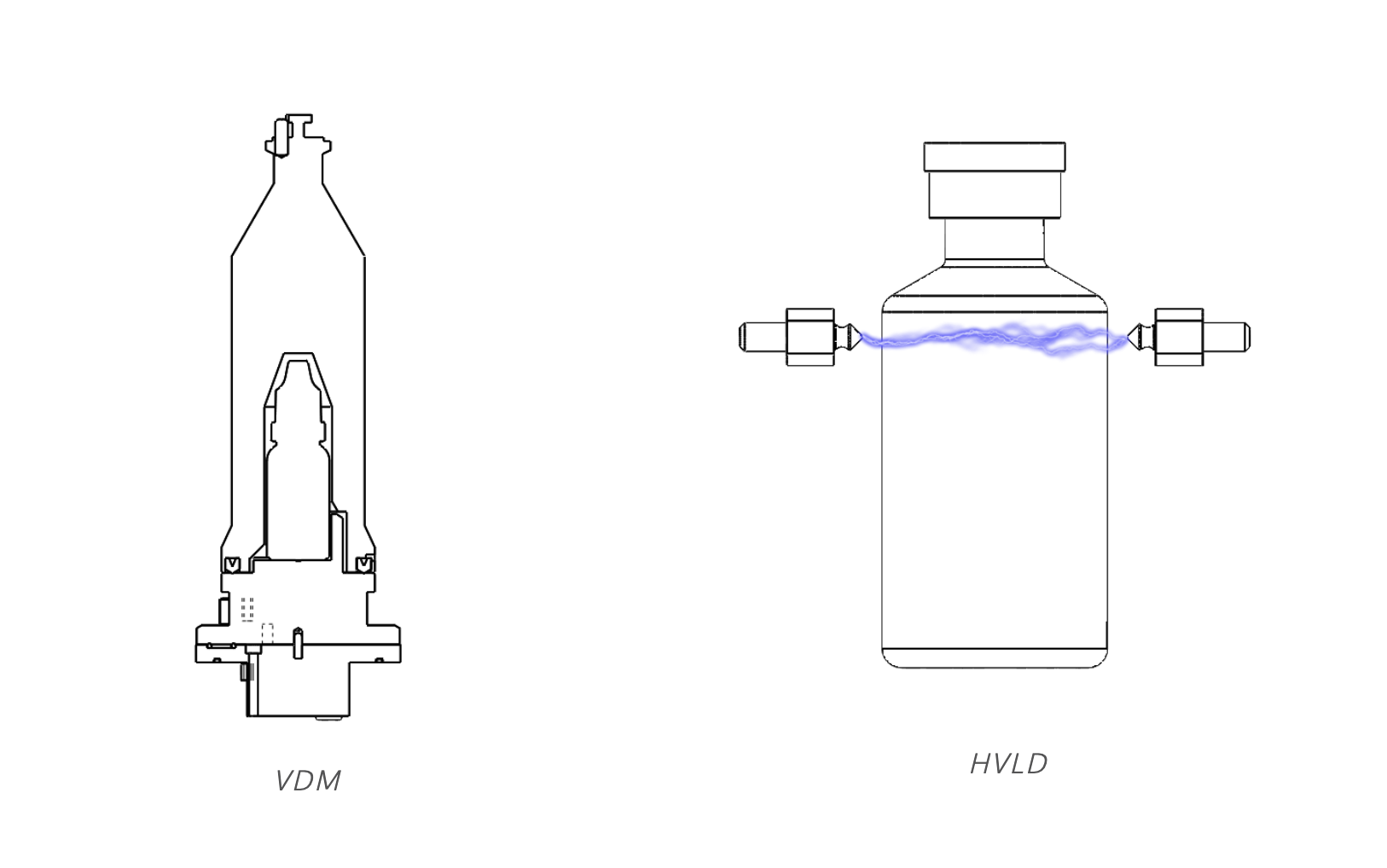
High Voltage Leak Detection (HVLD) is a test method that applies a high-voltage potential across a liquid-filled container to detect electrical conductivity changes caused by leaks.
When a defect is present, a measurable current passes through the package where there should be none, indicating a breach in the container.
HVLD is often used for rigid containers like:
- Pre-filled syringes
- Glass or plastic vials
- Ampoules
However, its performance is highly dependent on the conductivity of the solution inside the container and the stability of the container shape, making it less suitable for flexible, large-volume packaging, like IV bags.
The Limitations of HVLD with IV Bags
HVLD works by passing a microcurrent through a liquid-filled container and monitoring for conductivity changes caused by a leak.
While effective in certain formats like vials and syringes, HVLD struggles when applied to IV bags.
- Seam and Weld Limitations. Most IV bag failures occur at seams or fused welds. HVLD often misses these defects because they may not create the conductive path needed for detection.
- Dependence on Fluid Conductivity. HVLD requires conductive solutions. Bags containing viscous products, plasma derivatives, or non-conductive formulations are much harder to test reliably.
- Instability with Flexible Bags. IV bags are large, pliable, and filled with moving liquid. HVLD signals can become unstable, making repeatable and consistent detection challenging.
“HVLD may offer speed in some applications, but for IV bags it introduces blind spots that manufacturers cannot afford." - Gianmarco Pincelli, Technical Sales Manager
What is Vacuum Decay Leak Detection?
Vacuum decay leak detection is a deterministic, non-destructive CCIT method that places a filled container (such as an IV bag) in a vacuum chamber. The chamber is evacuated to a set pressure, and sensors monitor for changes over time. If a leak is present, gas escapes from the container, causing a measurable pressure rise.
The process is simple, repeatable, and compliant with regulatory standards including:
- USP <1207>
- ASTM F2338
- EU GMP Annex 1
Vacuum Decay is suitable for a wide variety of packaging, including: flexible IV bags, pouches, blister packs and rigid containers where non-destructive testing is required.
How does Vacuum Decay testing work? Let us show you here!
Why Vacuum Decay Outperforms HVLD for IV Bag Leak Testing
When it comes to IV bag integrity, not all test methods perform equally. Both High Voltage Leak Detection (HVLD) and Vacuum Decay are recognized CCIT methods, but when applied to flexible IV bags, Vacuum Decay has clear advantages that manufacturers cannot overlook.
- Seam and Weld Coverage. Unlike HVLD, Vacuum Decay detects leaks across the entire bag, including welds, seams, and ports, where most integrity failures occur.
- Resilient to Liquid Movement. Because the method measures pressure over time, Vacuum Decay is not disrupted by shifting liquid inside the bag. The result is a stable, repeatable test even for large or partially filled bags.
- Validated and Compliant. Vacuum Decay is an established, deterministic, non-destructive method referenced in USP <1207>, ASTM F2338, and EU Annex 1. It provides the regulatory confidence manufacturers require.
Moisture Sensitivity and False Rejects
Both HVLD and Vacuum Decay can be affected by surface moisture on IV bags, which may lead to high false reject rates—a costly challenge in pharmaceutical manufacturing.
However, ongoing innovations such as neural network-based anomaly detection in Vacuum Decay systems are changing this landscape. These advanced capabilities help:
- Stabilize test results under varying moisture and humidity conditions.
- Significantly reduce false rejects by distinguishing borderline cases more accurately.
- Eliminate workarounds—such as excluding certain bag areas from inspection—that can compromise integrity and throughput.
This means manufacturers can achieve both maximum inspection coverage and higher process efficiency.
Operational Impact: Throughput and Efficiency
By delivering more sensitive, stable, and adaptive leak detection, Vacuum Decay systems can:
- Maintain or improve throughput by reducing false rejects and unnecessary downtime.
- Ensure full inspection coverage without compromising output.
- Provide consistent data for process validation and control.
The result is higher productivity without sacrificing quality or compliance.
High Voltage Leak Detection vs. Vacuum Decay (Comparison Chart)

|
Category |
High Voltage Leak Detection (HVLD) |
Vacuum Decay (VD) |
|
Test Method |
Detects conductivity when a leak allows microcurrent to pass through a defect |
Measures pressure changes in a vacuum chamber due to gas leakage |
|
Container Compatibility |
Best for rigid, conductive liquid-filled containers like pre-filled syringes and glass vials |
Ideal for flexible and rigid packaging, including IV bags, pouches, blisters, and non-conductive fluids |
|
Leak Detection Sensitivity |
Limited sensitivity, especially for non-conductive or viscous solutions |
High sensitivity to microleaks, even with plasma or non-conductive fluids |
|
Suitability for IV Bags |
Poor – struggles with seams, welds, and liquid movement in flexible bags |
Excellent – detects leaks in welds, seams, ports; unaffected by bag flexibility or fluid dynamics |
|
Impact of Solution Conductivity |
Requires conductive solutions for accurate results |
Not dependent on liquid conductivity |
|
Repeatability and Stability |
Can be unstable in flexible containers with shifting liquids |
Stable, repeatable results regardless of fill level or movement |
|
Regulatory Compliance |
Not referenced in USP <1207> or Annex 1 |
Referenced in USP <1207>, ASTM F2338, and EU GMP Annex 1 |
|
Audit Trail and Data Traceability |
Limited – typically lacks built-in reporting or digital documentation |
Robust – supports 21 CFR Part 11, digital audit trail, and electronic reporting |
Learn more about High Voltage Leak Detection vs Vacuum Decay.
Why The Right Testing Method Matters
Pharmaceutical professionals, especially those responsible for sterile fill-finish, QA, R&D, and packaging engineering, face increasing pressure to adopt deterministic, regulatory-aligned, and non-destructive testing methods.
For products like IV bags, the choice of leak detection method directly impacts product integrity, compliance, and operational efficiency. Manufacturers in injectables, biologics, parenterals, and plasma derivatives are shifting toward methods like Vacuum Decay that ensure full seam, weld, and port inspection while reducing waste and rework.
View products designed to support pharmaceutical industry testing.
Vacuum Decay Testing: The Reliable Choice for IV Bags
While HVLD remains a recognized technique in pharmaceutical leak detection, its limitations with flexible IV bags particularly around seams, liquid variability, and conductivity make it a risky choice.
Vacuum Decay, especially when enhanced with AI-driven analytics, offers superior sensitivity, stability, and operational efficiency.
For pharmaceutical manufacturers seeking to maximize product safety, regulatory compliance, and line performance, Vacuum Decay-based systems, like Bonfiglioli Engineering’s IVB Flex, represent the most compelling solution.
Learn more about the IVB Flex now, or contact our team directly to discuss your unique needs.
FAQ
We are not just a machine manufacturer. We are your trusted partner for packaging integrity testing and analysis through feasibility studies, technical expertise, validation packages, product handling and custom-built solutions.
